Thursday, 11 April 2013

Reclining Buddha in Bangkok

Reclining Buddha (Phra Buddhasaiyas) in Viharn Phranorn, Wat Pho
Sanam Chai Road and Maharaj Road, Phra Nakhon, Bangkok, Thailand

There are many things that Bangkok is famous for - the King, the river and its floating markets, the nightlife that makes your world an oyster and shopping, to name a few attractions. But what makes the modern city unique and distinguishable from other megacities is the presence of (well yeah, Thai characters but aside from that) Buddhist temples or wats- and they embellish both the streetscape and the skyline. With the population 96% Buddhist, you might as well check out at least one when in Bangkok, and if you must enter only one, let it be Wat Pho, the home of the beloved image of the Reclining Buddha.

Officially Wat Phra Chettuphon Wimon Mangkhlaram , Wat Pho, also popularly known as Temple of the Reclining Buddha, is within the Rattanakosin district, the heart of city, the site of its founding and consequently an area with high concentration of the usual tourist destination. It is just right beside the Grand Palace.

As the oldest and biggest temple complex in Bangkok, Wat Pho offers many things that provide a glimpse of Thai culture and history, as well as of Theravada Buddhism. Scattered on its grounds are hundreds of statues of Buddha and guards and 91 chedis. Its halls are decorated with exquisite murals. It has a monastery where interaction with monks is allowed. Traditional Thai massage is also offered in the place, being the birth place of Thai massage, for a fee of course. 

But the center of attraction is the massive statue of the Reclining Buddha, Phra Buddhasaiyas in Thai, itself. Constructed under the reign of Rama III, the image is made of stuccoed bricks and covered with gold leaves. from head to foot it is 46 meters long. The head is 15 meters high while the feet 3 meters high. The statue's width is 5 meters. Also notable on the statue is the mother of pearl illustration of 108 images of Buddha displayed at the soles of both of its feet.

Tuesday, 2 April 2013

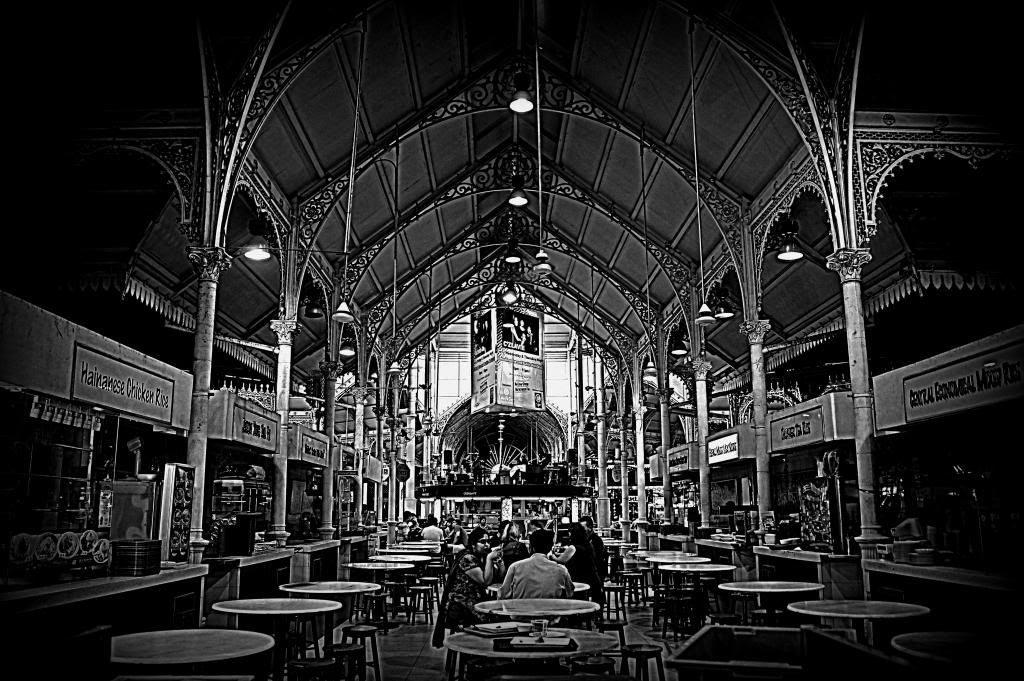
It's the Lau Pa Sat experience

Lau Pa Sat Festival Market
18 Raffles Quay, Singapore

Literally meaning "old bazaar" in Hokkien Chinese, Lau Pa Sat, or officially Telok Ayer Market has a long history that dates back to 1825.

Originally a market and much closer to the river, the structure in its present form- with its distinctive Victorian steel ornamentation was designed by Municipal Engineer James MacRitchie in 1894, closely following the original octagonal shape of the first large version of the market designed by George Drumgoole Coleman in 1836.

Located in Downtown Core, the market was eventually surrounded by new office towers and by 1973 it was converted into a food center. Since 1995, management of the food court is handled by Kopitiam, an operator that shares the name of the generic term for Singaporean coffee shop serve kaya toast, its egg and coconut paste-based national breakfast.

To this day the place is frequented by office workers and tourists and it's packed until very late at night especially outside where hawker food is sold.